
Industrial AI: Unleashing Productivity with Data Science
01 — The Opportunity
Process industry unleashes productivity by contextualising the process across an end-to-end, integrated data layer, enabling data science and machine learning to model productivity gains.
However, process industry is structurally complex, with much of the installed equipment old enough that it was never built to generate the data points needed to understand the required context. Blind spots prevent a full contextualisation of cause and effect across the production process, end-to-end, and retrofitting sensors to close those gaps is expensive and may not deliver ROI — particularly for proprietary OEM software solutions, if not integrating with other platforms.
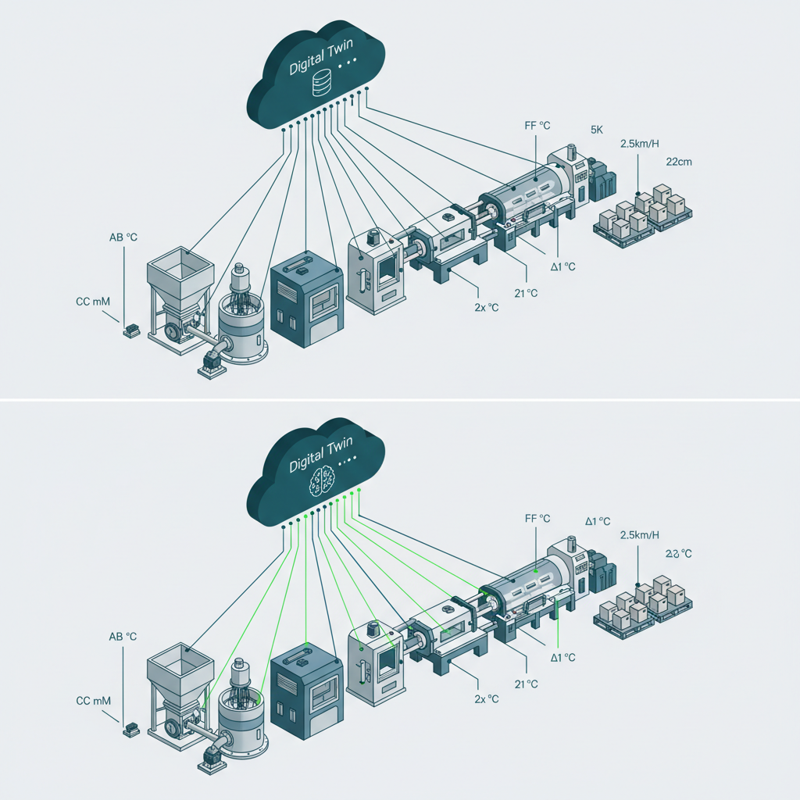
Vendor lock-in and ageing, signal-poor machines can both be overcome through data science modelling — building Soft Sensors — within a single, independent integration layer where data sovereignty and process expertise remain with the process industry.
02 — The Approach
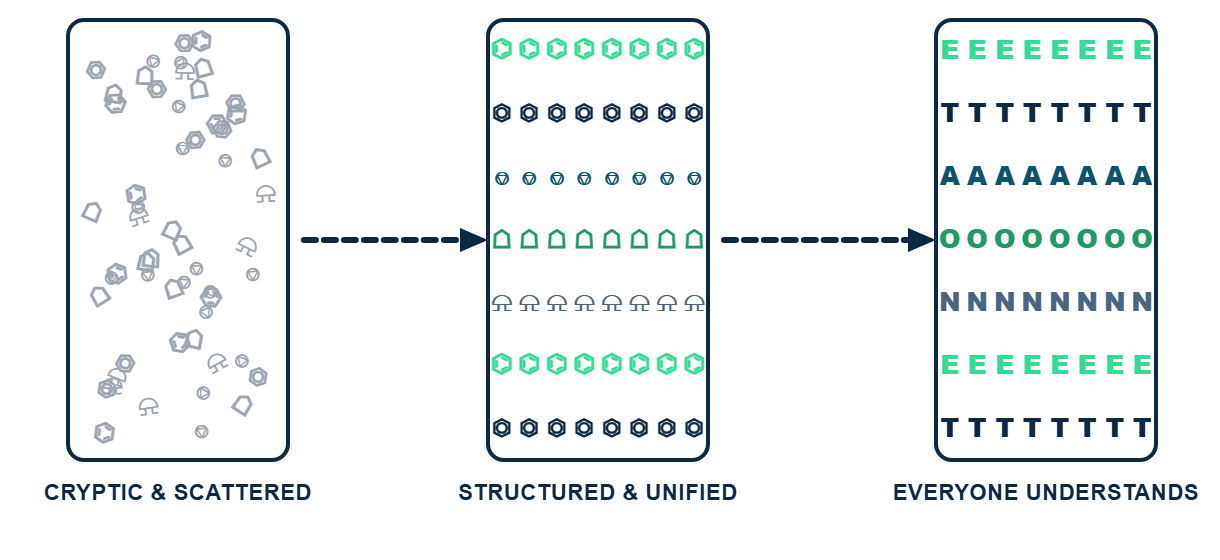
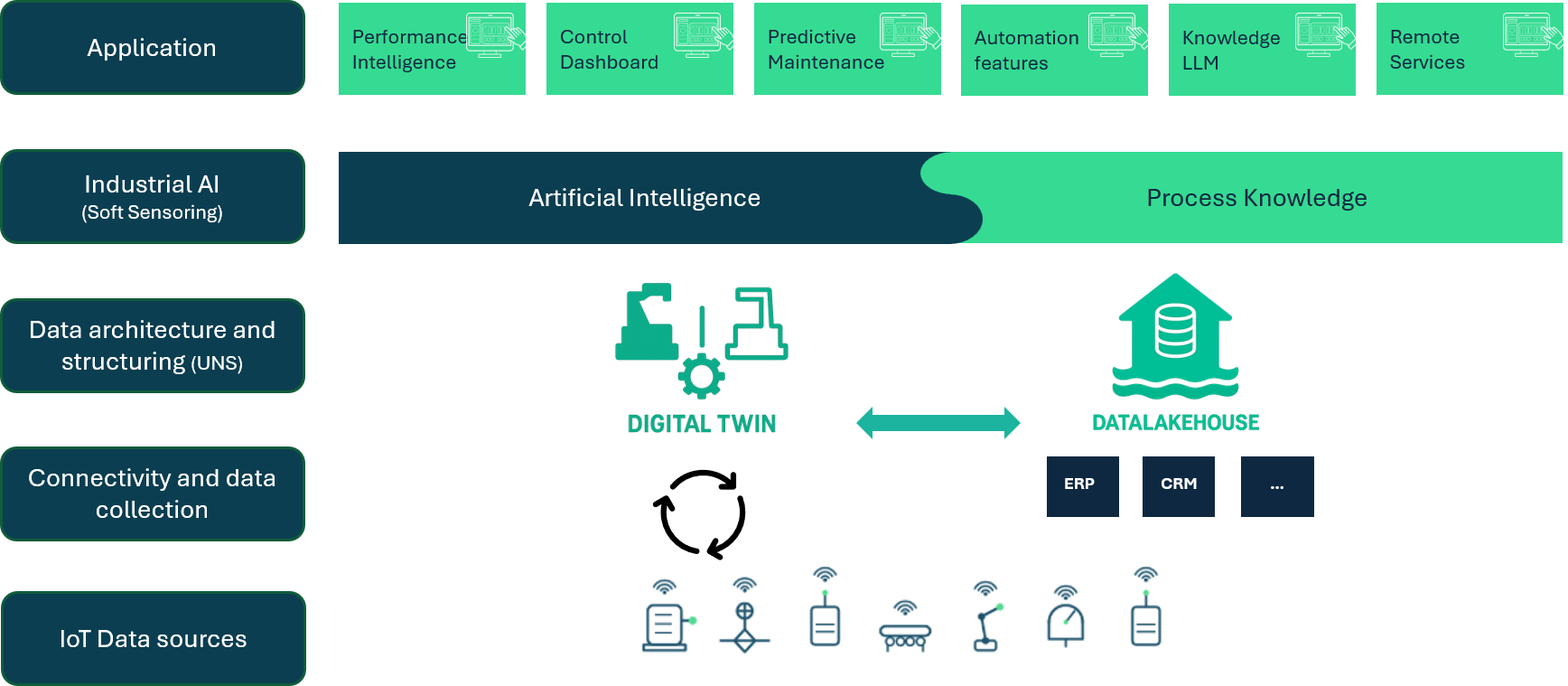
AIIOT, with technology partner Octotronic, builds an OEM-neutral integration and intelligence layer directly from the source: integrating all available native PLC/sensor tags plus using the universal objective signal inherent in every industry — energy. Raw electrical signals measured in Watt provide unique signatures to unfold blind spots in the process. Many physical changes in a process — load, friction, wear, material properties, temperature — show up as a change in the energy it takes to sustain it, making Watt one of the few signals that correlates with a wide range of process parameters. Regardless of age, all components running on electricity are captured in the Unified Namespace (UNS), forming a Baseline Digital Twin — the minimum digital representation achievable on any asset, irrespective of instrumentation. Based on this foundation, data science and industry process expertise build process-specific Soft Sensors that infer parameters with no physical sensor.
03 — The Architecture
04 — The Partners
05 — Market Landscape
| Proprietary OEM stacks | Vertically integrated hardware + software; deep functionality inside one vendor’s own installed base. | Not vendor-neutral; locks customers to one automation ecosystem; no cross-OEM digital twin. |
| Data-fusion / ontology platforms | Neutral semantic layer fusing ERP + MES + historized OT data into a knowledge graph / digital twin. | Assumes OT data is already instrumented and historized; no native sensing layer. |
06 — Why Now
Industries must continually raise productivity to keep pace with market demand and competition. OEMs have already optimised their own, isolated equipment, making further ROI harder to achieve. Integrated, end-to-end processes are now the biggest remaining source of productivity, and Digital Twin technology is the key enabler for capturing it.
As a side effect, this also compensates for the loss of experienced personnel, capturing their process know-how in the models and keeping quality consistent as that institutional knowledge is preserved.
07 — The Proof
A leading OEM in the wood-processing industry is rolling out the digital twin architecture across its installed base, turning it into a data-driven service business. With machine lifecycles exceeding 50 years, the OEM’s customers can apply industrial AI across every machine generation. Soft sensing enables AI-driven productivity even on legacy equipment. Delivered via cloud or private cloud, the platform scales from a single line to multi-site operations. It interoperates with all modern technology stacks and integrates with the digital solutions of the OEM’s customers.
08 — The Ask
AIIOT and its partners are seeking pilot customers — both process industry operators directly, and the machine builders and process experts who serve them — to validate the Baseline Digital Twin across a brownfield fleet.
Daniel Wahler — info@aiiot.ch